Since the beginning of January, we have been immersing ourselves in the life of Jesus as recorded by John, one of his closest companions.
And this week we approach the climax of the story. We call it passion week, or Holy Week. It begins today with Palm Sunday. It is called Palm Sunday because it commemorates the day that Jesus was welcomed as a king into Jerusalem with palm branches waving and laid down before him as he rode into the city.
John records the praises of the people:
“Hosanna!”
“Blessed is he who comes in the name of the Lord!”
“Blessed is the king of Israel!”
This is a moment filled with meaning. The crowd was declaring that this is the king. And if they are right, then everything is about to change. The people gathered in Jerusalem were not confused about what they were hoping for. They believed that God had promised a king, which would come from David’s line. This king would restore Israel and defeat their enemies and it would be a kingdom without end.
In their present moment, that meant one thing: Rome must fall.
So when Jesus entered the city that day, they interpreted everything through that lens. The palm branches, which symbolized liberation from Rome, the shouts of Hosanna, which means, “Lord, save us!”, and the proclamations of blessing for the king of Israel, all indicate that the people are prepared for a coronation.
But then there is one detail that does not fit. Jesus comes not on a warhorse as would be expected for a king preparing for battle, but on a donkey. And that detail changes everything.
The King of Promise
To understand what’s happening, we need to go back to where the hope for a saviour king was first promised. God said to David:
When your days are over and you rest with your ancestors, I will raise up your offspring to succeed you, your own flesh and blood, and I will establish his kingdom. He is the one who will build a house for my Name, and I will establish the throne of his kingdom forever. I will be his father, and he will be my son. When he does wrong, I will punish him with a rod wielded by men, with floggings inflicted by human hands. But my love will never be taken away from him, as I took it away from Saul, whom I removed from before you. Your house and your kingdom will endure forever before me; your throne will be established forever. (2 Samuel 7:12–16)
This was not just about Solomon or the kings who would follow. It was bigger than that. Even when the kingdom divided and then the kings failed and when the nations of Judah and Israel collapsed and the people were dispersed and exiled… Still, the promise remained.
The prophets kept pointing forward:
“The days are coming,” declares the Lord, “when I will raise up for David a righteous Branch, a King who will reign wisely and do what is just and right in the land. In his days Judah will be saved and Israel will live in safety. This is the name by which he will be called: The Lord Our Righteous Savior.” (Jeremiah 23:5–6)
“For to us a child is born, to us a son is given, and the government will be on his shoulders. And he will be called Wonderful Counselor, Mighty God, Everlasting Father, Prince of Peace. Of the greatness of his government and peace there will be no end. He will reign on David’s throne and over his kingdom, establishing and upholding it with justice and righteousness from that time on and forever. The zeal of the Lord Almighty will accomplish this.” (Isaiah 9:6–7)
So Israel lived with this tension: The kingdom is gone… but the promise is not. They were waiting for the king God had promised.
The King They Expected
Over time, that promise was interpreted through their circumstances. And their circumstances were political. There was oppression, occupation, and humiliation. So the promise of a king became the hope for a conqueror. A Messiah who would defeat enemies, cleanse the land, and restore national power.
Listen to the words of the Lord spoken through the prophet Isaiah and consider how a nation occupied by a hostile empire would interpret it:
“[The Lord] will cut down the forest thickets with an ax; Lebanon will fall before the Mighty One. A shoot will come up from the stump of Jesse; from his roots a Branch will bear fruit. The Spirit of the Lord will rest on him— the Spirit of wisdom and of understanding, the Spirit of counsel and of might, the Spirit of the knowledge and fear of the Lord— and he will delight in the fear of the Lord. He will not judge by what he sees with his eyes, or decide by what he hears with his ears; but with righteousness he will judge the needy, with justice he will give decisions for the poor of the earth. He will strike the earth with the rod of his mouth; with the breath of his lips he will slay the wicked. Righteousness will be his belt and faithfulness the sash around his waist.” (Isaiah 10:34–11:5)
Different Jewish groups imagined this differently, but the core expectation was the same. The Messiah will win the way kings always win: through military force.
So when Jesus arrives after performing many miracles, culminating in the raising of Lazarus from the dead, the crowd is convinced: this must be the promised king. And they are right. Jesus is the king.
But they are also deeply wrong about what that means. Jesus will not be crowned in the way they imagined their promised king would be crowned. He will not sit on an earthly political throne.
But he will be lifted up, exalted for all to see. And in doing so, he will draw all people to himself. Not by force. Not with military might. But in sacrificial humility, on a Roman cross.
The King of Life
“Jesus knew that the Father had put all things under his power, and that he had come from God and was returning to God; so he got up from the meal, took off his outer clothing, and wrapped a towel around his waist. After that, he poured water into a basin and began to wash his disciples’ feet, drying them with the towel that was wrapped around him.” (John 13:3–5)
Throughout his entire ministry, Jesus deliberately refused to become the kind of messiah king they expected and thought they needed. He avoided political titles. He spoke in ways about the law and the kingdom that confused them. He told people not to spread his identity. He slipped away from the crowds.
And yet, everything he did reveals true authority. Real power. It is authority over sickness, over demons. Power to remove the devastating effects of sin, power over death
And then he enters Jerusalem. He finds a donkey. A humble beast of burden. Not a warhorse preparing for battle. He is a king of peace. He has come not to conquer but to die.
He is saying: Yes, I am the king. But not the sort of king you think you need. This is where everything breaks for the people in Jerusalem. He is not going to overthrow Rome. He is not going to grab hold of power. He is not going to establish a political kingdom.
Instead, he prepares for betrayal and death by washing his betrayer’s feet, then sends him on his way.
Let’s jump over to John 18:1-14.
The promise to David was always about an eternal king of an eternal, all-encompassing kingdom. This was always the plan. His victory is not military. It is sacrificial. His rule is not enforced. It is received.
His kingdom cannot be understood by the powers of this world.
There is a famous painting of the crucifixion by Matthias Grünewald. It was painted for the Monastery of St. Anthony in Issenheim, France in 1512-1516.
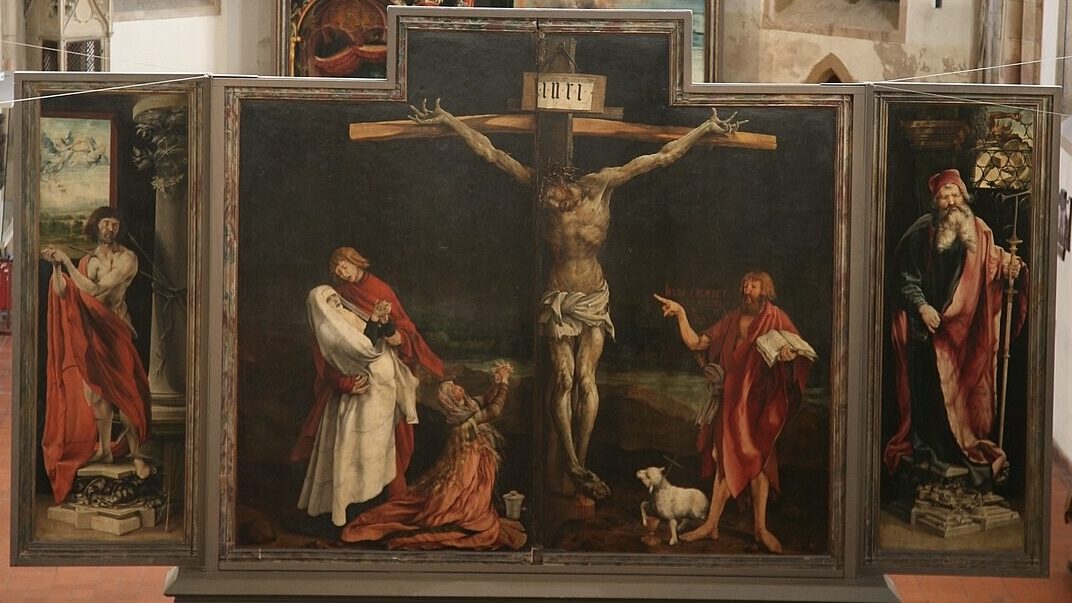
In the painting, we see a man standing beside the cross, pointing to Jesus. This man represents John the Baptist. But, in reality, John was not at the crucifixion. By that point, he had already been killed.
But the artist places him there anyway. John’s whole life had one purpose to point to Jesus. His finger is stretched out toward the crucified Christ, and beside him stands a lamb. It is the visual echo of his words from the beginning of John’s Gospel:
“Behold, the Lamb of God, who takes away the sin of the world.”
Even at the cross, the finger still points. As if to say: This is the Lamb.
In Revelation 5, a vision of heaven’s throne room is presented to John, the disciple of Jesus. That is the image everyone expects. The Lion, full of strength. Royal power. The conquering king. That is Palm Sunday triumphal entry language.
That is what the crowd expects as Jesus enters Jerusalem. A king. A victor. A ruler who will overthrow Israel’s oppressors.
Then John turns to look at the throne. And what does he see? This is one of the most important images in all of Scripture.
John hears of a lion. But he sees a lamb. The triumphant Lion is revealed as the sacrificial Lamb. Victory comes through sacrifice. Triumph comes through self-giving love. The throne is occupied by the crucified one.
This is what’s happening in John 12. The crowd wants a lion. But Jesus says the Son of Man must be lifted up. They expect a throne. But he is headed to a cross.
These are not opposites. The cross is the throne. The lifting up on the cross is the exaltation. The Lamb who is slain is the one who reigns.
This was always the plan. They were looking for the Lion, but God’s victory comes through the Lamb.
The kingdom of God does not defeat the world by becoming like Rome, but by revealing a completely different kind of power.
Conclusion
And here is our question today: How are we like the Jerusalem crowd? How do we interpret God’s promises? When we desire security, protection, control, how do we try to get it?
Do we think cultural influence or putting the “right” people in power is going to bring about the change we desire? Do we assume that God’s kingdom will come through the structures we understand?
Are we willing to have our expectations disrupted by the one who says, “Yes, I am king. Yes, I will reign. Yes, everything will be made right. But it will be the way of the Lamb.”
As we enter Holy Week and prepare to remember the death and resurrection of Jesus, let’s meditate on this message. Will we receive Jesus as he actually is or only as we expect him to be?
Because the king has come. And if we can see him for who he is then everything really does change.
Discover more from William Knelsen
Subscribe to get the latest posts sent to your email.